


Sabah Companies Urged to Enhance Compliance with Global Standards
7 February 2026
KOTA KINABALU: Sabah companies have been urged to strengthen compliance with international standards to enable their products and services to penetrate overseas markets and compete globally.
Deputy Chief Minister III and Minister of Industrial Development, Entrepreneurship and Transport Datuk Ewon Benedick said the move was crucial to ensuring local businesses remained competitive at the international level.
Citing data from the Malaysia External Trade Development Corporation (MATRADE) Singapore, he said that as of December 2025, only 261 companies from Sabah were registered with MATRADE out of a total of 12,742 Malaysian enterprises.
“This clearly shows the need for us to intensify our efforts to ensure that more products and services from local companies are developed to meet international market requirements and standards.
“One of my key priorities at this ministry is to enhance the standards and quality of products and services offered by Sabah entrepreneurs.
“With compliance to international standards such as Halal certification, MESTI and Environmental, Social and Governance (ESG) requirements, local companies will be better prepared to enter overseas markets,” he said.
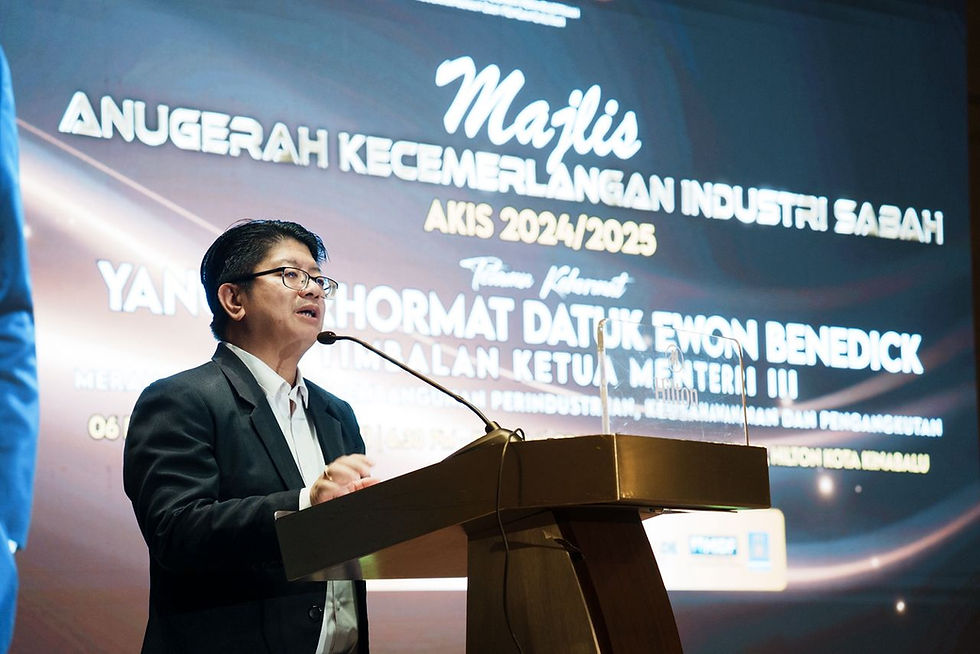
Ewon was speaking to reporters after officiating at the Sabah Industrial Excellence Awards (AKIS) ceremony here yesterday.
He said the ministry would continue to support the needs of local entrepreneurs and companies through appropriate policies and initiatives, including ensuring that the necessary assistance was provided to bring products and services to international markets.
“In terms of packaging, we will intensify efforts to develop this aspect as it is vital for positioning local products in international markets. This forms part of my major focus, beginning with the recognition given this evening,” he said.
Ewon noted that his observations showed a clear difference in product packaging before and after companies received guidance from the ministry.
“Feedback from programme participants indicates that their sales increased after improvements were made to product packaging, as it became more attractive and aligned with consumer expectations.
“Packaging plays a significant role in influencing consumer purchasing decisions. As such, this element will continue to be prioritised so that Sabah entrepreneurs can continue to benefit,” he said.
He added that the mentoring programmes implemented by the ministry were also aimed at raising awareness among entrepreneurs on the importance of obtaining key certifications such as Halal and ESG, which are essential for accessing international markets.
“These are major factors that influence consumer confidence overseas, while also helping entrepreneurs understand the importance of securing the required certifications,” he said.
In line with the Sabah First Vision, Ewon said scaling up small and medium industrial enterprises (SMEs) was among his main focuses, beginning with enhancing production capacity and capabilities, as well as strengthening product and service quality and standards.
“I would like to see more companies from Sabah, including start-ups, developed and capable of producing products or services that meet international market standards, including those of the Singapore market,” he said.
On AKIS, Ewon expressed hope that the recognition would serve as a catalyst for award recipients and other companies to continue progressing, sustain strong performance, strengthen innovation and emerge as industry leaders capable of competing globally.
“May this award inspire higher levels of achievement towards realising the aspiration of Sabah becoming an industrialised state by 2040,” he said.



Comments