


Loi Kok Liang Raises Buyer Protection and Fairness Issues in Building Management Bill Debate

30 April 2026
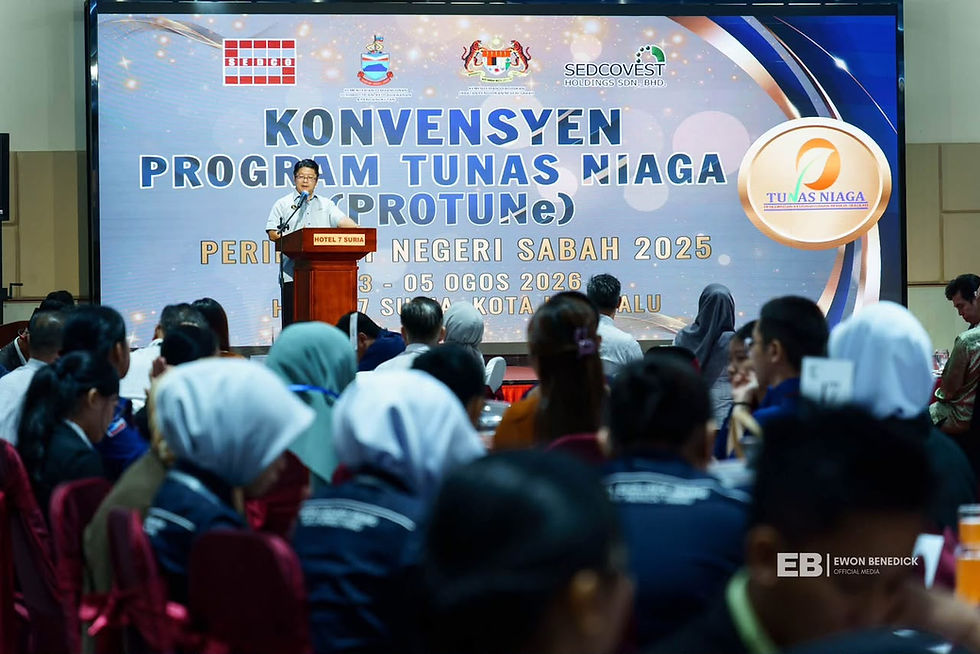
KOTA KINABALU: Api-Api State Assemblyman Loi Kok Liang raised a number of practical issues during his debate on the Building Management Bill (RUU Building Management), urging the government to take into account the real challenges faced by urban property buyers in the legislative process.
In his speech, he presented two specific examples to illustrate the existing imbalances within the current system, and stressed the need for clearer regulation through law.
Firstly, on the issue of maintenance fees and sinking funds, Loi pointed out that many condominium projects obtain their Occupation Certificate (OC) before all units are sold. In such cases, purchasers who have taken possession are required to begin paying maintenance fees and sinking fund contributions.
However, he questioned who should bear the cost for the unsold units.
He said, “If a project is only 70% sold, it means that the 70% of owners are effectively bearing the cost of maintaining the entire building.”
He emphasised that maintenance work is carried out for the whole building, not partially.
“Painting is not done for only 70% of the building. Grass is not cut for only 70%. Therefore, this situation is clearly unfair.”
He also noted that although some developers do make such payments, it is not consistent. On the other hand, when purchasers fail to pay, the management will take enforcement action, including imposing interest charges.
Therefore, he proposed that the law should clearly require all owners, including developers who still hold unsold units, to contribute to maintenance fees and the sinking fund, in order to ensure fairness in the system.
In his second example, Loi referred to the mixed development project Imago located in the city centre, where the condominium known as “The Loft” sits above the shopping mall. After The Loft obtained its OC, some purchasers, particularly investors, began operating short-stay businesses within their units.
However, such activities were initially blocked by the management, on the grounds that the Sale and Purchase Agreement (S&P) contained a clause stating that short-stay business was not allowed.
He pointed out that the purchasers subsequently brought the matter to court, producing evidence that the developer had marketed the project earlier as a “servicing residence,” implying that it could be used for both short-stay business and permanent residence.
He also noted that sales personnel under the developer had informed buyers that the units could be used for short-stay purposes. The case was eventually settled before any court ruling was made, and the management no longer prevented short-stay operations within The Loft.
From this case, he highlighted two major issues.
First, there was a mismatch between what was marketed by the developer and what was stated in the contractual agreement, which created confusion and disputes. He stressed that developers must determine and finalise the permitted use of a building before marketing it, and ensure that all promotional materials are consistent with contractual terms, so as to avoid misleading buyers and forcing them to seek legal recourse.
He further added that if developers ensure transparency and clarity from the outset, it would also help prevent conflicts within the building between owners who support short-stay businesses and those who oppose them.
Second, there was inconsistency in how the management enforced rules. Initially, short-stay activities were prohibited based on the S&P clause, but later they were no longer enforced, reflecting a lack of clear and consistent standards.
This creates the perception that management bodies appointed by developers can arbitrarily set and change rules, rather than operating within a fair, transparent and consistently applied legal or regulatory framework that must be respected by all parties.
He pointed out that such situations can lead to double standards and trigger disputes and dissatisfaction among property owners.
Loi said that such cases are not uncommon in urban buildings, and that purchasers are often the ones most affected.
He stressed that the Bill must be sufficiently comprehensive to address such situations.
“In many cases, buyers are in a very vulnerable and pressured position. My speech today is also to bring forward the voices of many urban purchasers.”
He also noted that although the Bill includes provisions relating to the application for subsidiary titles, there is still no clear timeline for when the titles must be issued.
“If possible, a reasonable timeframe should be set — for example, the subsidiary title must be delivered to purchasers within two years.”
In conclusion, he expressed hope that the Bill would provide sufficient protection for buyers while also maintaining fairness and clarity for developers.
On that basis, he expressed his support for the Bill.



Comments